


Sustainability Governance Structure
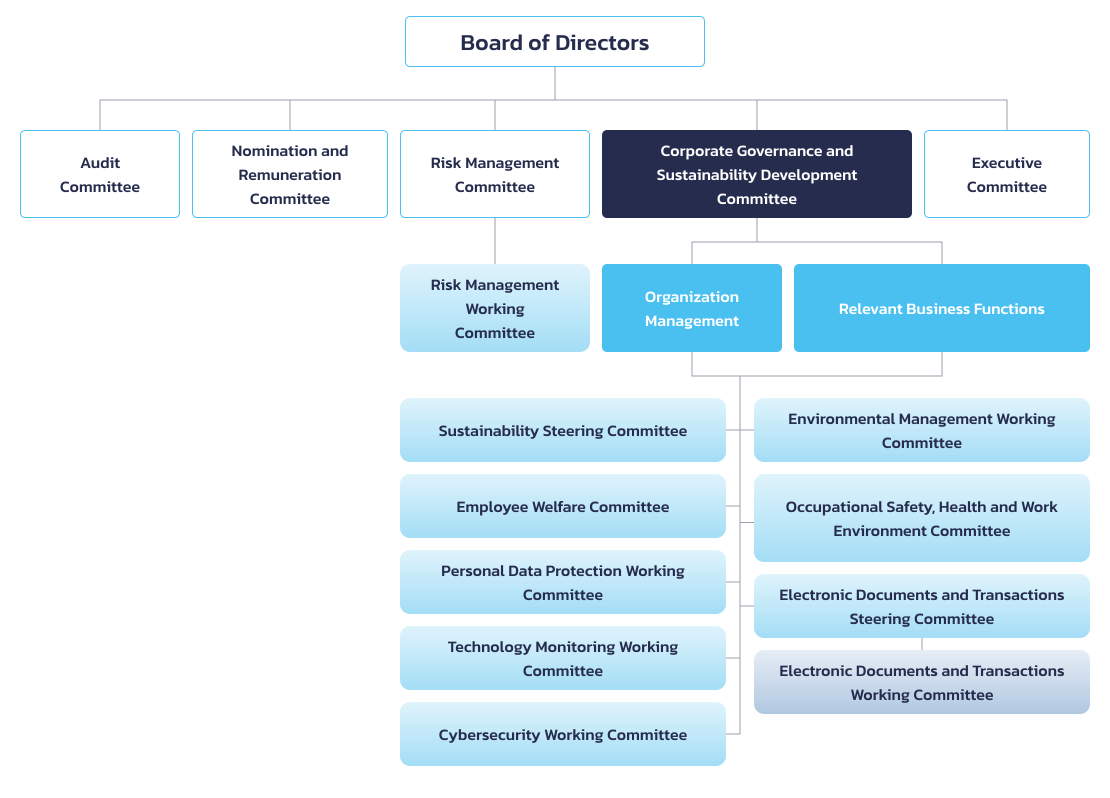
Turnkey Communication Services Public Company Limited (“TKC”) has established a sustainability governance structure to support transparent, efficient business operations aligned with the Company’s sustainable development goals. This structure encompasses governance, risk management, and ESG (Environmental, Social, Economic and Governance) operations at all levels of the organization. The Board of Directors has assigned the Corporate Governance and Sustainability Committee to be responsible for setting policies, strategic direction, and key issues related to sustainability operations. The Committee regularly reports progress to the Board of Directors, as well as reviews performance, impacts, and risks related to environmental, social, economic, and governance contexts to ensure that operations align with the established objectives.
At the operational level, the Company has integrated sustainability concepts into its business processes throughout the value chain. A Sustainability Steering Working Group is responsible for driving overall policies and strategies, coordinating with all relevant departments, and ensuring concrete implementation in line with the Company’s targets.
Sustainability Governance Structure

Board of Directors

Risk Management Committee

Corporate Governance and Sustainability Development Committee
In addition, the Company has appointed a supporting working group to collaborate with the Sustainability Steering Working Group. This group is responsible for reporting operational performance, progress, and key issues to the Corporate Governance and Sustainability Committee at least once a year, as well as summarizing stakeholder engagement results. This enables the Committee to acknowledge stakeholder concerns, expectations, and appropriate responses to key issues. These include:

Sustainability Steering Committee

Environmental Management Working Committee

Employee Welfare Committee

Occupational Safety, Health, and Working Environment Committee

Personal Data Protection Working Committee

Technology Monitoring Working Committee

Cybersecurity Working Committee

Risk Management Working Committee

Electronic Documents and Transactions Steering Committee
Establish strategic directions for electronic documents and electronic transactions to enhance organizational efficiency.
-
Electronic Documents and Transactions Working Committee
Support and promote the implementation of electronic document and electronic transaction systems, monitor progress, and continuously develop related practices.
In addition, these working groups collaborate with the Risk Management Working Group to integrate sustainability issues into the Company’s Enterprise Risk Management (ERM) process. This involves incorporating risk-related data and recommendations into strategic analysis and risk assessment, enabling the Company to identify, manage, and monitor sustainability risks comprehensively. It also supports the Board of Directors in making decisions aligned with the Company’s long-term sustainable growth objectives.
