

Key Material Issues of the Business
Sustainability Risk Management
In today’s business environment, organizations face multifaceted sustainability challenges. If risks are not managed systematically, they may impact operational efficiency, corporate reputation, and the Company’s long-term business viability. Therefore, the Company conducts comprehensive assessments and establishes risk management approaches addressing sustainability-related impacts across all three dimensions. These consist of 12 material issues, as outlined below:
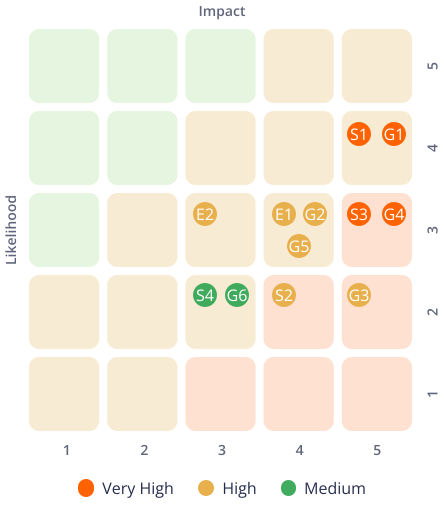
E1Greenhouse Gas Management Risk
Climate change causes natural disasters to become more severe and frequent, affecting business continuity, operating costs, and infrastructure readiness, including increasing pressure from stricter environmental regulations.
E2Resource Efficiency Risk
Inefficient use of resources such as water, energy, and paper may increase operating costs, impact the environment, reduce competitiveness, and not align with stakeholder expectations on sustainability.
S1Human Capital Development Risk
Rapid technological changes may cause employee skills to become misaligned with business requirements, affecting operational efficiency and the Company's competitiveness. Continuous development of employee skills and capabilities is therefore necessary. In addition, increasing competition for highly skilled labor may affect the Company's ability to retain qualified and experienced personnel.
S2Human Rights and Fair Labor Practices Risk
Lack of proper human rights and labor management may lead to complaints, legal risks, reputational damage, and loss of stakeholder trust.
S3Occupational Health and Safety Risk
Operations both in office and on-site pose risks of accidents and illness; if not properly managed, they may impact employee health, work continuity, and costs from work stoppages or compensation.
S4Product and Service Responsibility Risk
Rapid technological advancements may render the Company’s products or services obsolete, potentially affecting product and service quality, competitiveness, customer satisfaction, customer safety, and the Company's ability to generate sustainable revenue in the future.
G1Information Security Risk
Unauthorized access or data leakage may affect stakeholder trust, business continuity, financial damage, and significant legal risks.
G2Business Innovation Risk
Failure to develop new innovations or business models in line with market changes may result in stagnant revenue, reduced competitiveness, and excessive reliance on short-term projects.
G3Governance and Compliance Risk
Changes in laws and regulations such as climate law and carbon tax may increase cost and complexity; poor governance may affect trust and corporate image.
G4Customer Relationship Management Risk
Ineffective management may reduce satisfaction, lose business opportunities, and increase contract non-renewal risk, directly impacting revenue and reputation.
G5Business Partner Risk
Workforce development through knowledge sharing and certification with partners reduces dependency risk while enhancing internal capability and long-term business opportunities.
G6Procurement Risk
Cost volatility and reliance on foreign suppliers may affect cost, delivery delays, and disruptions from geopolitical events.
| Code | Key Risk | Dimension | Risk Level | Opportunity | Management Measures |
|---|---|---|---|---|---|
| Environmental | |||||
| E1 | Greenhouse Gas Management Risk
Climate change causes natural disasters to become more severe and frequent, affecting business continuity, operating costs, and infrastructure readiness, including increasing pressure from stricter environmental regulations. |
Environmental | High | Develop Green Solutions business along with adjusting working models to be environmentally friendly, which can generate increased revenue. |
|
| E2 | Resource Efficiency Risk
Inefficient use of resources such as water, energy, and paper may increase operating costs, impact the environment, reduce competitiveness, and not align with stakeholder expectations on sustainability. |
Environmental | High | Reduce operating costs concretely and support a Green Organization image. |
|
| Social | |||||
|---|---|---|---|---|---|
| S1 | Human Capital Development Risk
Rapid technological changes may cause employee skills to become misaligned with business requirements, affecting operational efficiency and the Company's competitiveness. Continuous development of employee skills and capabilities is therefore necessary. In addition, increasing competition for highly skilled labor may affect the Company's ability to retain qualified and experienced personnel. |
Social | Very High | Reskill & Upskill programs, capability development with partners, develop 5G/IoT/AI skills, and specialized expertise development. |
|
| S2 | Human Rights and Fair Labor Practices Risk
Lack of proper human rights and labor management may lead to complaints, legal risks, reputational damage, and loss of stakeholder trust. |
Social | High | Reduce legal and reputational risks while increasing stakeholder confidence. |
|
| S3 | Occupational Health and Safety Risk
Operations both in office and on-site pose risks of accidents and illness; if not properly managed, they may impact employee health, work continuity, and costs from work stoppages or compensation. |
Social | Very High | Maintain occupational health and safety (OHS) quality under ISO 45001:2018 and keep zero workplace accident statistics. |
|
| S4 | Product Responsibility Risk
Rapid technological advancements may render the Company’s products or services obsolete, potentially affecting product and service quality, competitiveness, customer satisfaction, customer safety, and the Company's ability to generate sustainable revenue in the future. |
Social | Medium | Develop new services aligned with Global Megatrends and differentiate from competitors. |
|
| Governance and Economic | |||||
|---|---|---|---|---|---|
| G1 | Information Security Risk
Unauthorized access or data leakage may affect stakeholder trust, business continuity, financial damage, and significant legal risks. |
Governance and Economic | Very High | Expand digital infrastructure business to support long-term digital economy growth. |
|
| G2 | Business Innovation Risk
Failure to develop new innovations or business models in line with market changes may result in stagnant revenue, reduced competitiveness, and excessive reliance on short-term projects. |
Governance and Economic | High | Expand digital infrastructure and Smart Solutions to increase revenue diversification and stable recurring income. |
|
| G3 | Governance and Compliance Risk
Changes in laws and regulations such as climate law and carbon tax may increase cost and complexity; poor governance may affect trust and corporate image. |
Governance and Economic | High | Prepare for operations that create competitive advantage and increase stakeholder confidence. |
|
| G4 | Customer Relationship Management Risk
Ineffective management may reduce satisfaction, lose business opportunities, and increase contract non-renewal risk, directly impacting revenue and reputation. |
Governance and Economic | Very High | Build customer trust and increase revenue from existing customers. |
|
| G5 | Business Partner Risk
Workforce development through knowledge sharing and certification with partners reduces dependency risk while enhancing internal capability and long-term business opportunities. |
Governance and Economic | High | Enhance workforce capabilities and strengthen strategic partnerships. |
|
| G6 | Procurement Risk
Cost volatility and reliance on foreign suppliers may affect cost, delivery delays, and disruptions from geopolitical events. |
Governance and Economic | Medium | Diversification of supplier bases across different regions to reduce geopolitical risks and maintain anti-corruption standards, thereby promoting long-term credibility and transparency. |
|
