

Respect for Human Rights and Fair Labor Practices
Supporting the Sustainable Development Goals




Targets
- Human rights complaints 0 cases
- Communicate and raise awareness on respect for human rights to employees at all levels 100% by 2026
Performance


Challenges and Opportunities
The technology industry faces challenges related to non-standard labor, rights violations, and risks in health and safety, especially in the installation sector. Without strict monitoring systems, this may affect credibility and create legal and reputational risks.
Turnkey Communication Service Public Company Limited (“TKC”) is committed to respecting human rights and managing labor fairly, by adhering to international labor standards, rejecting the use of child labor and forced labor both within the organization and throughout the supply chain. The Company establishes requirements for suppliers to ensure that all parties conduct business responsibly and fairly. The Company promotes an equal and safe working environment by ensuring employee rights in terms of appropriate compensation, fair working hours, and opportunities for career development, supporting equality and non-discrimination in the workplace, together with measures on employee health and safety.
The Company also enhances transparent and safe labor practices through supply chain auditing systems, grievance mechanisms, and labor protection measures. These not only help reduce risks, but also build confidence among investors, employees, and customers, enhance business competitiveness, and support sustainable growth.



Management Approach and Value Creation
The Company places importance on protecting and respecting fundamental rights and freedoms of individuals equally and fairly, therefore adheres to treating all stakeholder groups with respect, non-discrimination, no use of forced or illegal labor, no support for harassment or abusive behavior in all forms, promoting equality, diversity, and inclusion at all levels, as well as promoting fair compensation by considering remuneration based on employee value and capability. The Company supports freedom of expression, association, and collective bargaining, creating a good working environment, and places importance on protecting stakeholder data security. In this regard, the Company is committed to avoiding human rights violations in all aspects, therefore has established human rights due diligence (Human Rights Due Diligence: HRDD) to assess human rights impacts that have occurred or may occur within the business value chain, and provides appropriate remediation measures in cases where human rights violations occur, together with establishing accessible and safe reporting or complaint channels.
Human Rights Due Diligence: HRDD
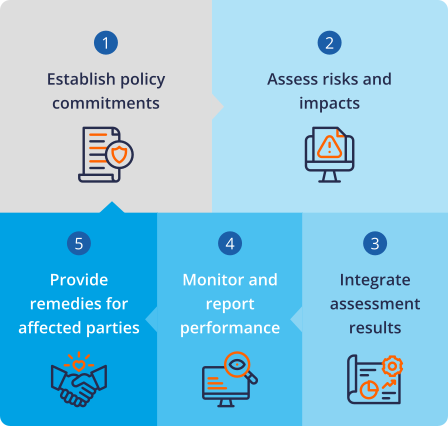
The Company recognizes the importance of human rights in business operations, therefore has initiated the implementation of a comprehensive human rights due diligence process to strengthen human rights management to be comprehensive and systematic. The Company has conducted human rights risk assessments to identify and assess human rights risks related to the Company’s operations, both existing and potential, covering labor rights, customer rights, supplier rights, and community and environmental rights. In this regard, the Company has integrated the assessment results into internal management in order to determine measures to prevent and mitigate human rights risks, as well as to monitor and report performance results, including establishing channels for whistleblowing and complaints, and providing appropriate remediation in cases where human rights violations occur. This comprises 5 steps as follows:
Risk Management Approaches Related to the Company’s Operations
| Risk Issue | Risk Control Measures |
|---|---|
| Fair Labor Practices |
|
| Health and Safety in the Working Environment |
|
| Personal Data Protection of Stakeholders |
|
| Health and Safety of Stakeholders |
|
| Discrimination Against Customers / Business Partners |
|
| Environmental Impact from Organizational Operations |
|
Whistleblowing and Complaint Channels and Complaint Handling Process

Whistleblowing and Complaint Channels
The Company provides channels for stakeholders to submit inquiries or complaints regarding incidents that may be considered human rights violations through the Compliance Department. Complaints can be submitted through the following channels:



Complaint Handling Process
- The Compliance Unit, consisting of personnel with appropriate knowledge, expertise, and impartiality, is responsible for reviewing and handling complaints within 7 working days from the date the complaint is received.
- The Compliance Unit will collect relevant information and evidence, conduct investigations or interviews with related parties, and review the facts of the case. The unit will also determine appropriate corrective actions, preventive measures to reduce the risk of future human rights violations, and mitigation measures for affected parties, taking into account the overall impact. Where appropriate, disciplinary actions or legal proceedings against the offender will be considered. A report will then be prepared and submitted to the Executive Committee for consideration within 15 working days from the date the complaint is received.
- Relevant departments will implement the resolutions or actions approved by the Executive Committee and report the outcomes of such actions back to the committee.
- The Compliance Unit is responsible for compiling and maintaining records of all complaints, which will be used as supporting information for the preparation of the Company’s annual report.

Whistleblower Protection Measures

Human Rights Remediation Measures

Disciplinary Measures
Fair Treatment of Labor in Accordance with Human Rights Principles
Diversity, Equity, and Inclusion (DEI)
The Company places importance on equality and gender equity, including fair employment, by considering employment without limitation based on gender identity or sexual orientation, and focusing primarily on knowledge, capabilities, and qualifications relevant to the position. The Company establishes remuneration without unlawful discrimination and free from bias, provides skills training for work performance, offers appropriate and fair compensation, and has policies on occupational safety and health in the workplace, etc.
As the Company has not yet employed persons with disabilities, it complies with the requirements of the Persons with Disabilities Empowerment Act B.E. 2550 (2007), Section 34, by contributing to the Fund for Empowerment of Persons with Disabilities in lieu of employing persons with disabilities, in order to support and develop the quality of life of persons with disabilities in society in a sustainable manner.

Employee Diversity by Type

Total is 52%

Total is 48%
Workforce Diversity by Work Location
Classified by work location
| Regional Operations Center | Total Number of Employees | Percent |
|---|---|---|
| Central Region (Bangkok and Metropolitan Area) | 541 | Bangkok and Metropolitan Area 98% |
| Northern Region (Chiang Mai) | 3 | Region 2% |
| Northern Region (Phitsanulok) | 1 | |
| Southern Region (Surat Thani) | 3 | |
| Northeastern Region (Nakhon Ratchasima) | 2 | |
| Total | 550 | 100% |