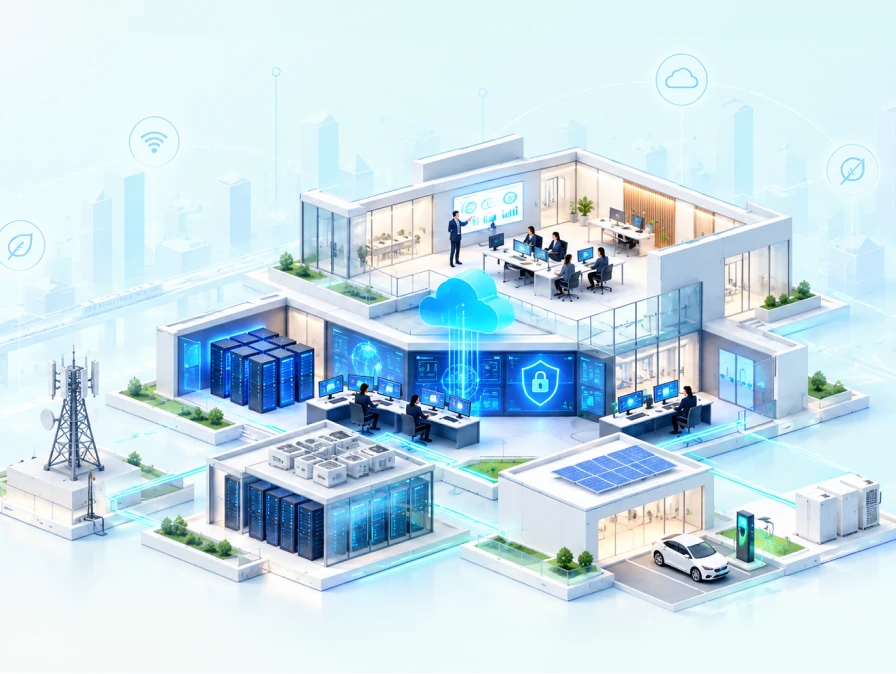

Turnkey Communication Services Public Company Limited (“TKC”) is committed to conducting its business responsibly under sustainable development principles by integrating environmental, social, and good corporate governance (ESG) considerations into all aspects of its operations. The Company strives to create long-term value for all stakeholders while prioritizing the development of technology and innovation to enhance the nation’s digital infrastructure. At the same time, TKC emphasizes efficient resource management, respect for human rights and employee well-being, data security, and transparent, fair, and accountable business practices.

TKC firmly believes that business growth should go hand in hand with creating positive impacts on society and the environment, in order to jointly drive the organization, communities, and the country toward a stable and sustainable future.

Sustainability Management Goals

The Company is committed to sustainable organizational development by integrating environmental, social, and economic and governance (ESG) dimensions into its operations. This is complemented by the analysis and management of risks that may affect business performance in the short, medium, and long term, in order to enhance adaptability and strengthen organizational resilience effectively.

The Company also focuses on increasing corporate value through digital transformation, supporting sustainable business operations in alignment with the United Nations Sustainable Development Goals (SDGs). TKC aims to create sustainable value for all stakeholders across the value chain in a balanced manner. In addition, the Company promotes and enhances the quality of life in communities and society, enabling them to meet their basic needs, which forms a fundamental foundation for long-term sustainable development, as outlined below:

SDGs 1: No Poverty
SDGs 2: Zero Hunger
SDGs 3: Good Health and Well-being
SDGs 4: Quality Education
SDGs 5: Gender Equality
SDGs 6: Clean Water and Sanitation
SDGs 7: Affordable and Clean Energy
SDGs 8: Decent Work and Economic Growth
SDGs 9: Industry, Innovation and Infrastructure
SDGs 10: Reduced Inequalities
SDGs 11: Sustainable Cities and Communities
SDGs 12: Responsible Consumption and Production
SDGs 13: Climate Action
SDGs 14: Life Below Water
SDGs 15: Life on Land
SDGs 16: Peace, Justice and Strong Institutions
SDGs 17: Partnerships for the Goals
Environmental Dimension
SDGs 6: Clean Water and Sanitation
SDGs 7: Affordable and Clean Energy
SDGs 12: Responsible Consumption and Production
SDGs 13: Climate Action
  • Reduce electricity consumption per employee by 2.5% by 2029, compared to the 2025 base year

  • Reduce water consumption per employee by 2.5% by 2029, compared to the 2025 base year

  • Reduce paper consumption by 2.5% by 2029, compared to the 2025 base year

  • Reduce greenhouse gas emissions by 5% by 2029, compared to the 2025 base year
Social Dimension
SDGs 1: No Poverty
SDGs 3: Good Health and Well-being
SDGs 4: Quality Education
SDGs 5: Gender Equality
SDGs 8: Decent Work and Economic Growth
SDGs 10: Reduced Inequalities
SDGs 16: Peace, Justice and Strong Institutions
SDGs 17: Partnerships for the Goals
  • Zero human rights complaints
  • Average training of at least 8 hours per employee per year
  • Employee engagement level above 80%
  • Voluntary employee turnover rate not exceeding 10%
  • Lost Time Injury Rate (LTIR) of employees at zero
  • Promote local employment in project areas to at least 50% by 2029, compared to the 2025 base year

Governance and Economic Dimension
SDGs 8: Decent Work and Economic Growth
SDGs 9: Industry, Innovation and Infrastructure
SDGs 12: Responsible Consumption and Production
SDGs 16: Peace, Justice and Strong Institutions
SDGs 17: Partnerships for the Goals
  • Corporate Governance Report (CGR) of Thai Listed Companies Evaluation Results At the 5-star level by 2028
  • Increase the proportion of recurring revenue to at least 40% of total revenue by 2029
  • Enhance human capital productivity in revenue generation by 20% by 2029, compared to the 2025 base year
  • Maintain customer satisfaction levels above 80%

Sustainability Strategy

The Company has established guidelines and action plans to conduct its business while considering the impacts on the environment, society, and the governance and economy, with the goal of achieving continuous and long-term sustainable development without compromising natural resources or the quality of life of future generations. The Company’s sustainability approach is implemented under the “T-K-C” sustainability framework, as described below.
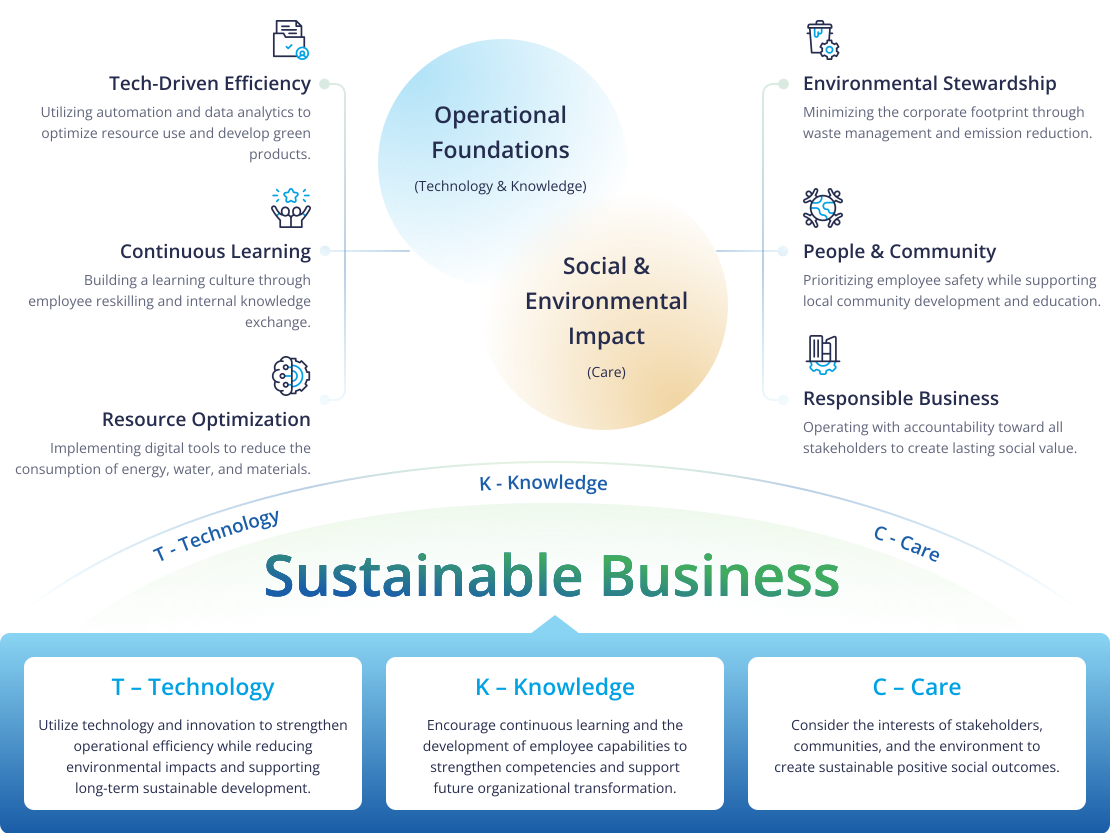
Sustainability Strategy

Action Plans to Achieve Sustainability Management Objectives

E

Environmental Dimension

Target / Timeline Short-term Build awareness and initiate projects Medium-term Integrate into core operations and expand implementation Long-term Drive transformation, leadership, and innovation
Reduce water consumption per employee by 2.5% by 2029 (compared to 2025 base year)
  • Inspect and prevent water leakage
  • Launch “Water Conservation Campaign”
  • Install reminder signage in high-usage areas
  • Install water-saving faucets and sanitary equipment
  • Implement Smart Meter systems for real-time water monitoring
  • Regularly maintain and replace damaged water fixtures
  • Support water conservation initiatives
Reduce electricity consumption per employee by 2.5% by 2029 (compared to 2025 base year)
  • Employee campaign “Switch Off – Adjust – Unplug”
  • Maintain electrical equipment regularly
  • Install automated lighting and air-conditioning controls
  • Install solar cells
  • Install motion sensors
  • Continuous maintenance of electrical equipment
  • Expand renewable energy from solar power
  • Further expand renewable energy usage
Reduce paper consumption by 2.5% by 2029 (compared to 2025 base year)
  • Implement Lock Print to reduce printing errors
  • Introduce E-Signature systems for document approval
  • Use environmentally friendly paper
  • Encourage business partners to adopt E-Signature systems
  • Monitor and evaluate paper consumption
  • Promote a Paperless Organization
Reduce greenhouse gas emissions by 5% by 2029 (compared to 2025 base year)
  • Zero Waste Program to promote proper waste separation
  • Reduce single-use plastics
  • Use food waste digesters for organic waste
  • Assess and identify greenhouse gas reduction opportunities
  • Strengthen waste segregation measures
  • Study feasibility of EV or Hybrid vehicles
  • Set more ambitious targets toward Net Zero emissions

S

Social Dimension

Target / Timeline Short-term Build awareness and initiate projects Medium-term Integrate into core operations and expand implementation Long-term Drive transformation, leadership, and innovation
Promote local employment in project areas >50% by 2029 (compared to 2025 base year)
  • Promote job opportunities through local employment offices and educational institutions
  • Collaborate with educational institutions to develop talent
  • Provide specialized training for local workers
  • Expand training programs for local employees and educational partners
Voluntary employee turnover rate <10%
  • Conduct detailed Exit Interviews
  • Implement Individual Development Plans (IDP)
  • Review employee benefits and welfare programs
  • Conduct regular exit interview analysis to identify root causes and improve organizational development
  • Continuously develop employee capabilities
  • Foster a Work-Life Integration culture
  • Continuous employee upskilling and capability development.
  • Cultivation of an inclusive, diverse, and resilient workplace culture.
  • Regular review of career paths, succession plans, and compensation structures to maintain competitiveness within the industry.
Employee engagement level >80%
  • Monitor employee engagement surveys
  • Review and improve employee benefits and working conditions
  • Organize employee engagement activities
  • Implement Individual Development Plans (IDP)
  • Promote recognition programs beyond monetary rewards
  • Implement physical and mental health programs
  • Strengthen a Work-Life Integration culture
  • Foster an organizational culture that promotes flexibility and inclusivity
Average training >8 hours per employee annually
  • Conduct training needs assessments
  • Develop annual training plans including ESG-related topics
  • Utilize E-learning platforms to enhance accessibility
  • Evaluate training outcomes and apply learning to improve work efficiency
  • Develop ESG-oriented leadership
  • Develop internal mentoring and coaching leadership programs
Zero human rights complaints
  • Establish a Compliance unit
  • Provide confidential and reliable grievance channels
  • Maintain zero complaint performance
  • Sustain zero complaint performance
Zero Lost Time Injury Rate (LTIR)
  • Conduct regular occupational health and safety risk assessments
  • Implement emergency drills and safety training
  • Ensure safety equipment is properly maintained and ready for use
  • Strengthen the Occupational Safety, Health and Work Environment Committee
  • Provide annual employee health check-ups
  • Maintain zero LTIR performance
  • Sustain zero LTIR performance

G

Governance and Economic Dimension

Target / Timeline Short-term Build awareness and initiate projects Medium-term Integrate into core operations and expand implementation Long-term Drive transformation, leadership, and innovation
Achieve 5-Star Corporate Governance Rating (CGR) by 2028
  • Identify gaps from the annual CGR assessment
  • Improve disclosure practices, shareholder rights, and related governance processes
  • Prepare sustainability reports in accordance with international standards
  • Continuously improve corporate governance practices and disclosure standards
  • Maintain governance standards and further enhance practices to align with international assessments
Recurring revenue >40% of total revenue by 2029
  • Develop new businesses focusing on long-term service contracts
  • Analyze products and services with potential to generate recurring revenue
  • Invest in technologies or platforms supporting recurring revenue models
  • Adjust service models to strengthen recurring revenue streams
  • Develop customer retention strategies to reduce contract cancellations and increase customer lifetime value
Increase human capital revenue productivity by 20% by 2029 (compared to 2025 base year)
  • Continuously Upskill and Reskill employees to keep pace with technological changes
  • Enhance employee capability to improve revenue generation
  • Sustain continuous improvement in revenue productivity
Customer Satisfaction Score > 80%
  • Conduct customer satisfaction surveys regularly to support continuous improvement
  • Improve processes based on customer feedback
  • Resolve customer complaints promptly
  • Communicate information transparently
  • Review and improve quality control processes
  • Apply customer feedback quickly and effectively to enhance services
  • Strengthen customer satisfaction and trust
  • Develop excellent after-sales services
  • Maintain a strong and stable customer base
  • Strengthen long-term customer confidence in the Company’s operations

Development of Sustainability Management Practices

The Company examines feedback received from stakeholder groups regarding its vision, mission, and strategic business direction, considering both internal and external contexts, including risks and opportunities that may affect its operations. This information is used to constantly develop and refine the Company’s material sustainability concerns. The Company also considers stakeholders’ expectations, concerns, and suggestions to enhance its stakeholder engagement approach. This process supports the identification of material issues and enables the Company to respond appropriately to stakeholder expectations while driving sustainable business growth.